An adventure in multifoundational Mathematics 2.0: the cycle double cover theorem in ZFC with Grace17

If you have arrived here directly, welcome. Grace17 is a proof assistant for mathematics based on set theory: a small trusted kernel for classical ZFC, a modern elaborator and proof language above it, a growing mathematical library called Cumulus, and a browser Workbench in which every proof opens and can be stepped through interactively, all the way down to the axioms of set theory. I am building it because I want a mainstream ergonomic proof assistant whose foundation is ZFC in first-order logic with equality. Please see the Introduction for more background on the system and what I'm hoping to achieve. Now, onto the cycle double cover theorem!
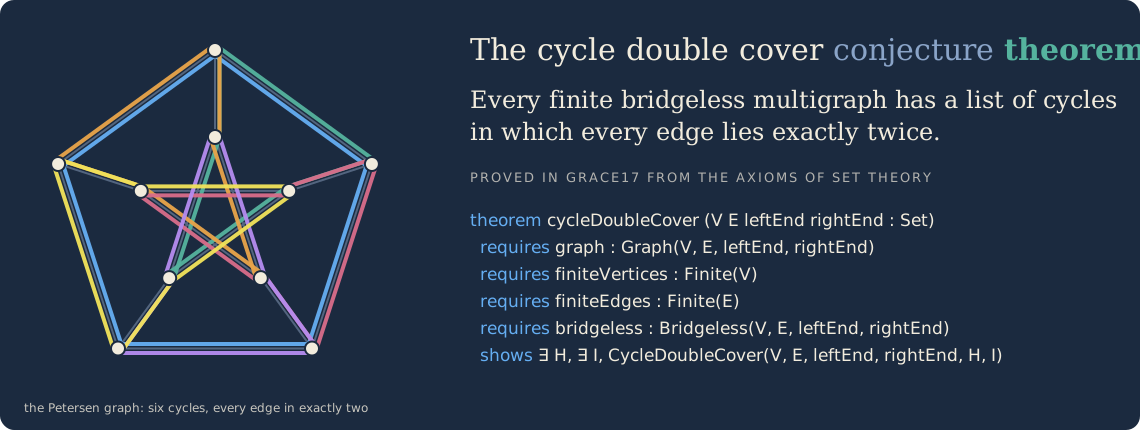
Does every finite bridgeless multigraph have a list of cycles in which every
edge lies exactly twice? George Szekeres posed this question in 1973, and Paul
Seymour posed it again in 1979, and for half a century it was an open problem.
Major progress was made by Jaeger, Alspach, Goddyn, Zhang, and Huck: Jaeger
showed that it is enough to settle the snarks, Alspach, Goddyn, and Zhang
settled every graph with no Petersen minor, and Huck showed that a smallest
counterexample would have girth at least twelve. Then, in June and July of
2026, a model at OpenAI found a proof: a first one on June 24th, resting on
Seymour's six-flow theorem, and a second on July 9th, unconditional. The proof
was written down, checked in Lean 4, made
public on July 10th, and further polished for human understanding by Sang-il
Oum in an exposition. Grace17 now proves it
too, from the axioms of set theory. The theorem is
Grace.Cumulus.GraphTheory.DoubleCover.Theorem.cycleDoubleCover,
and the forty modules under it are our library Cumulus's
developments of graph theory, including edge sets, cuts, components, tree
packings, flows over the two-element field, and double covers.
This page is my account of how the proof was planned and carried out, and of what I learned about doing a proof of this size in Grace17. The short version: a blueprint written in an afternoon, based on Oum's exposition and the Lean proof, five layers proved by agents using the Grace17 agent interface in about nine hours of agent time across a day and a half, 521 theorems in forty-one modules, a certificate that an independent Grace17 proof checker replays from axioms of set theory in under three seconds, and a theorem whose statement is a formula of ZF. Needless to say, I believe this is an encouraging result :-).
How the problem was chosen#
I wanted a challenge problem for Grace17: a recent substantial AI-assisted result with a published proof, big enough that both our mathematical library Cumulus and Grace17's core elaboration and proof automation would be stressed and likely have to grow in the process. I asked Tim Chow for a suggestion, and he proposed the cycle double cover conjecture (thank you, Tim!). It was a great choice. It is a substantial recent result in graph theory which is deep but not too large in terms of its dependencies, it was obtained in a "Mathematics 2.0" fashion, it has both a Lean formalization and an exposition written to improve human understanding of the proof, and almost none of its dependencies were in Cumulus.
What is proved#
A multigraph is a vertex set V, an edge set E, and two functions leftEnd
and rightEnd from E to V. That is all the hypothesis Graph(V, E, leftEnd, rightEnd) below says: the two end functions map edges to vertices,
and nothing more. Loops and parallel edges are allowed, since nothing forbids
an edge whose ends coincide or two edges with the same ends. A cut of X ⊆ V
is the set of edges with one end in X and one outside, and a graph is
bridgeless when no cut has exactly one edge. A cycle is a nonempty connected
edge set in which every vertex has degree zero or two, a loop contributing both
of its ends.
theorem cycleDoubleCover (V E leftEnd rightEnd : Set)
  requires graph : Graph(V, E, leftEnd, rightEnd)
  requires finiteVertices : Finite(V)
  requires finiteEdges : Finite(E)
  requires bridgeless : Bridgeless(V, E, leftEnd, rightEnd)
  shows ∃ H, ∃ I, CycleDoubleCover(V, E, leftEnd, rightEnd, H, I)
proof
  obtain ⟨H, I, cover⟩ := Bridgeless.even_double_cover
    with graph, finiteVertices, finiteEdges, bridgeless
  exact EvenDoubleCover.to_cycles with graph, finiteVertices, cover
The proof is the last two steps of the whole development: the even double cover
from the eight-flow theorem and the expansion, then its cycles.
CycleDoubleCover(V, E, leftEnd, rightEnd, H, I) says that I is finite, H
is a function from I into the subsets of E, every H(i) is a cycle, and
every edge lies in exactly two of the H(i).
Our Grace17 proof follows Oum's exposition. The eight-flow theorem of Jaeger and Kilpatrick gives three even edge sets that together cover every edge. A rotation system expands each vertex into a ring, which makes the graph cubic and loopless without changing whether it is bridgeless. A cubic graph with such a cover has two-element labels on its edges with even local multiplicity; these come from solving a system of parity equations, and the system is solvable because the dual obstruction computation of the proof rules out any obstruction. The labels give an even double cover, the cover projects back through the expansion, and every even edge set splits into cycles.
Two results the exposition cites are proved here as background results in Cumulus. The tree packing theorem of Nash-Williams and Tutte is proved by Kaiser's short argument: refine the trivial partition along the colors until every color is internally connected, give each edge the level at which its ends part, and exchange an edge of least level in a cycle of the last color for one of lower level. It is a beautiful argument, three pages on paper, and it is now a chain of eight modules that I think reads quite naturally next to the paper. The eight-flow theorem then follows from three spanning trees with no common edge in the doubled graph, with contraction of a two-edge cut for the graphs that are not three-edge-connected.
Compared to Oum's proof, we deviate in one main way: Oum's exposition reasons about dimensions of vector spaces over the two-element field, and our proof states that linear algebra in the language of finite sets instead: a vector is a set of coordinates, the sum is the symmetric difference, a matrix is a relation between rows and columns, and a row equation asks for the parity of a finite set. The alternative, that a system is solvable exactly when no left-kernel vector sees an odd right-hand side, is proved by eliminating one column at a time. No vector spaces, no dimensions, no bases. Symmetric differences and the parity of an intersection are enough, and to my eye they are lovelier.
In Grace17, we can always audit the proofs of any theorems to find out which
axioms were used. The axiom audit of cycleDoubleCover lists the axioms of ZF,
classical logic, and one use of the global choice function, in the last step,
which picks a cycle decomposition for each even set of the cover. A finite
choice would remove it, and I may do that. The modules that use choice are
DoubleCover.CycleCover, DoubleCover.CubicLabeling,
DoubleCover.EvenDoubleCover, and DoubleCover.Theorem. Everything else,
through the eight-flow theorem and the expansion, is in ZF.
The blueprint#
Following the standard approach in the Lean community, I started by creating a
Grace17 blueprint for the proof. A blueprint is a module root of its own,
blueprints/, holding modules whose definitions are final and whose theorems
are stated in full and admitted with sorry, which means their proofs still
have to be spelled out. The import graph is the dependency graph of the proof.
The key is that the whole blueprint should be explicit and correct enough to be
admitted into Grace17's logic, and should then constitute a sketch of a proof,
modulo the filling in of the details which eliminate the individual sorrys. A
status script counts proved and admitted theorems per module. Filling it in
means replacing admissions with proofs, one theorem at a time. A module whose
last sorry admission is eliminated by a proof is promoted into Cumulus under
the home named in its header.
The blueprint for this theorem had 17 modules in 5 layers and 108 theorems. I
wrote it with Claude's assistance in an afternoon by following the Oum
exposition: the parity algebra of edge sets, tree packing, parity systems,
flows, double covers. This is when key design decisions were made, especially
about representation. Edge sets are subsets of E. Degrees count edge ends, so
loops need no special case anywhere. Connectivity along an edge set is closure
of a vertex set under the edges. A partition of V has a quotient multigraph.
Vectors over the two-element field are finite sets with △ as the sum; the dot
product is the parity of an intersection; the span of a vector is the pair {∅, p}. Flow values are subsets of 3 and label values subsets of 𝒫(3).
Seven of the 108 statements in the blueprint turned out to be (slightly) wrong as written, a fact the agents surfaced and helped me fix during the theorem proving process. I come back to them below.
The exposition and the Lean proof#
The mathematics came from Oum's exposition. I read it closely while writing the blueprint, and the blueprint is where it was turned into set theory. The proving agents then worked systematically from the blueprint's statements. The exposition's mathematics, as the blueprint states it, went through without a change. What the exposition assumes, we either proved (tree packing) or went around (Fleischner's splitting lemma).
The Lean proof was a major achievement and helped inform the writing of the
blueprint. Before writing it I read the main file of openai/cdc-lean and the
outline of its declarations, and the shape of its argument, the expansion of
each vertex by a rotation system in place of a reduction through Fleischner's
lemma, the projection of a cover back through the expansion, and the
decomposition of even edge sets into cycles at the end. We did not port the
Lean files, and in fact the proving agents were not given access to them,
though that would also be a very interesting route to take.
The layers, with a theorem from each#
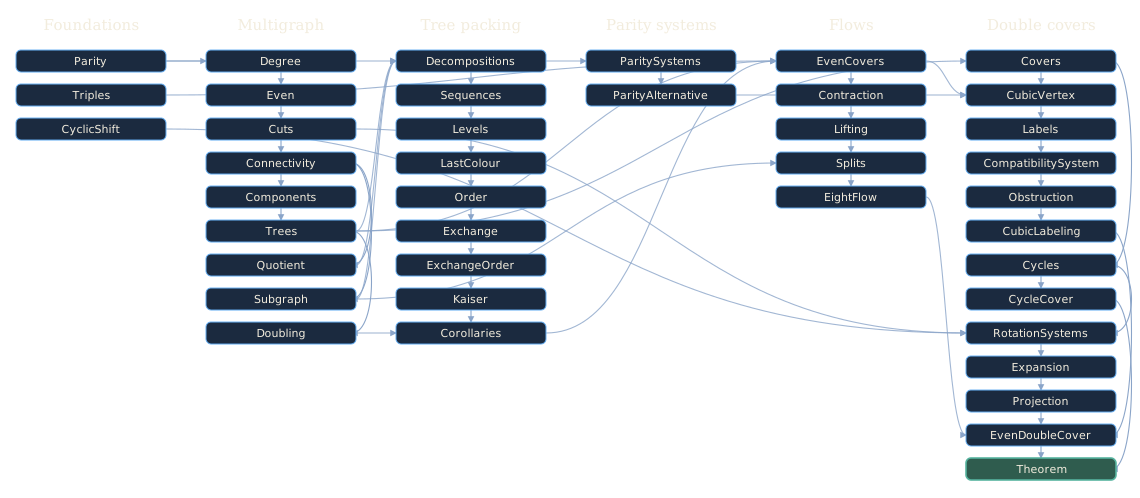
The import graph above is the proof's dependency graph, and the five areas are the blueprint's five layers. Below I'll share a theorem or two from each, as they stand in Cumulus; each opens in the Workbench at its line.
Multigraphs. An even edge set crosses every cut an even number of times, so a bridge lies in no even edge set, and a graph that is 2-edge-connected is bridgeless:
theorem EvenEdgeSet.crossing_even (V leftEnd rightEnd F X : Set)
  requires finiteVertices : Finite(V)
  requires even : EvenEdgeSet(V, leftEnd, rightEnd, F)
  requires subset : X ⊆ V
  shows Even(cardinality(crossing(leftEnd, rightEnd, F, X)))
proof
  have finiteF := even.left
  have finiteX := Finite.subset with finiteVertices, subset
  -- The degrees over X are even, so their sum is.
  have evens : ∀ v ∈ X, Even(degreeWeights(X, leftEnd, rightEnd, F)(v))
    intros v hv
    rw degreeWeights.value with finiteF, hv
    exact even.right with v, (subset with v, hv)
  rw crossing.parity with finiteX, finiteF
  exact natSum.even_of_even_weights
with finiteX, (degreeWeights.natural with finiteF), evenstheorem EdgeConnected.bridgeless (V E leftEnd rightEnd : Set, k : Nat)
requires two : 2 ≤ k
requires ends : ∀ e ∈ E, leftEnd(e) ∈ V ∧ rightEnd(e) ∈ V
requires connected : EdgeConnected(V, E, leftEnd, rightEnd, k)
shows Bridgeless(V, E, leftEnd, rightEnd)
proof
intros X bound
by_cases trivial : X = ∅ ∨ X = V
. rw [(crossing.trivial with ends, trivial), cardinality.empty]
arith
. have nonempty : X ≠ ∅ by tauto
have proper : X ≠ V by tauto
have many := connected with X, bound, nonempty, proper
arithTree packing. Kaiser's proof of the theorem of Nash-Williams and Tutte, and the corollary the flows need, three spanning trees of a 3-edge-connected graph with no common edge:
theorem treePacking (V E leftEnd rightEnd : Set, k : Nat)
  requires graph : Graph(V, E, leftEnd, rightEnd)
  requires finiteVertices : Finite(V)
  requires finiteEdges : Finite(E)
  requires nonempty : V ≠ ∅
  requires condition : PackingCondition(V, E, leftEnd, rightEnd, k)
shows TreePacking(V, E, leftEnd, rightEnd, k)theorem EdgeConnected.three_trees (V E leftEnd rightEnd : Set)
requires graph : Graph(V, E, leftEnd, rightEnd)
requires finiteVertices : Finite(V)
requires finiteEdges : Finite(E)
requires nonempty : V ≠ ∅
requires connected : EdgeConnected(V, E, leftEnd, rightEnd, 3)
shows ∃ T, FunctionBetween(T, 3, 𝒫(E)) ∧
(∀ i ∈ 3, SpanningTree(V, leftEnd, rightEnd, T(i))) ∧
T(0) ∩ T(1) ∩ T(2) = ∅Parity systems. Linear algebra over the two-element field in the language of finite sets: a system is solvable exactly when no left-kernel vector sees an odd right-hand side.
theorem paritySystem.alternative (A R C b : Set)
  requires finiteRows : Finite(R)
  requires finiteColumns : Finite(C)
  requires matrix : A ⊆ R × C
  requires side : b ⊆ R
  shows (∃ t, Solves(A, R, C, b, t)) ↔ ¬(∃ y, Obstructs(A, R, C, b, y))
proof
  constructor
  . intros solvable obstructed
    obtain ⟨t, solution⟩ := solvable
    obtain ⟨y, obstruction⟩ := obstructed
    exact Solves.not_obstructed
      with finiteRows, finiteColumns, matrix, solution, obstruction
  . intro unobstructed
    have solvable := paritySystem.solvable with finiteRows, finiteColumns
    exact solvable with A, b, matrix, unobstructed
Flows. Three spanning trees with no common edge give an even cover, and with contraction of two-edge cuts every finite bridgeless graph has one; the induction is on the number of vertices.
theorem EvenCover.of_three_trees (V E leftEnd rightEnd T : Set)
  requires graph : Graph(V, E, leftEnd, rightEnd)
  requires finiteVertices : Finite(V)
  requires finiteEdges : Finite(E)
  requires trees : FunctionBetween(T, 3, 𝒫(E)) ∧
    (∀ i ∈ 3, SpanningTree(V, leftEnd, rightEnd, T(i)))
  requires sparse : T(0) ∩ T(1) ∩ T(2) = ∅
shows ∃ F, EvenCover(V, E, leftEnd, rightEnd, F)theorem eightFlow (V E leftEnd rightEnd : Set)
requires graph : Graph(V, E, leftEnd, rightEnd)
requires finiteVertices : Finite(V)
requires finiteEdges : Finite(E)
requires bridgeless : Bridgeless(V, E, leftEnd, rightEnd)
shows ∃ F, EvenCover(V, E, leftEnd, rightEnd, F)
proof
have natV := cardinality.nat with finiteVertices
have all := eightFlow.of_vertex_count at cardinality(V)
exact all with V, E, leftEnd, rightEnd, graph, finiteVertices, finiteEdges,
bridgeless, (LessEqual.reflexive at cardinality(V))Double covers. The expansion by a rotation system is cubic, a cubic
graph with an even cover has an even double cover indexed by the subsets of
3, an even edge set splits into cycles, and the pieces assemble:
theorem expansion.cubic (V E leftEnd rightEnd σ : Set)
  requires graph : Graph(V, E, leftEnd, rightEnd)
  requires finiteEdges : Finite(E)
  requires rotation : RotationSystem(V, E, leftEnd, rightEnd, σ)
  requires degrees : ∀ v ∈ V, 2 ≤ degreeIn(leftEnd, rightEnd, E, v)
  shows Cubic(halfEdges(E), expandedEdges(E),
expandedLeft(E, σ), expandedRight(E, σ))theorem Cubic.even_double_cover (V E leftEnd rightEnd F : Set)
requires graph : Graph(V, E, leftEnd, rightEnd)
requires finiteVertices : Finite(V)
requires finiteEdges : Finite(E)
requires cubic : Cubic(V, E, leftEnd, rightEnd)
requires cover : EvenCover(V, E, leftEnd, rightEnd, F)
shows ∃ H, EvenDoubleCover(V, E, leftEnd, rightEnd, H, 𝒫(3))theorem EvenEdgeSet.cycle_decomposition (V leftEnd rightEnd F : Set)
requires finiteVertices : Finite(V)
requires ends : ∀ e ∈ F, leftEnd(e) ∈ V ∧ rightEnd(e) ∈ V
requires even : EvenEdgeSet(V, leftEnd, rightEnd, F)
shows ∃ D, Finite(D) ∧ (∀ C ∈ D, Cycle(V, leftEnd, rightEnd, C)) ∧
(∀ C ∈ D, ∀ B ∈ D, C ≠ B → Disjoint(C, B)) ∧ ⋃(D) = F
proof
have finite := even.left
have bound : cardinality(F) ≤ cardinality(F) by arith
exact EvenEdgeSet.decomposition_of_size
at V, leftEnd, rightEnd, F, cardinality(F)
with finiteVertices, ends, F, Subset.reflexive, bound, eventheorem Bridgeless.even_double_cover (V E leftEnd rightEnd : Set)
requires graph : Graph(V, E, leftEnd, rightEnd)
requires finiteVertices : Finite(V)
requires finiteEdges : Finite(E)
requires bridgeless : Bridgeless(V, E, leftEnd, rightEnd)
shows ∃ H, ∃ I, EvenDoubleCover(V, E, leftEnd, rightEnd, H, I)
proof
have active := activeVertices.graph with graph
have finiteActive : Finite(activeVertices(V, E, leftEnd, rightEnd)) :=
Finite.subset with finiteVertices, activeVertices.subset
have bridgelessActive := activeVertices.bridgeless with bridgeless
have degrees := activeVertices.degrees with graph, finiteEdges, bridgeless
obtain ⟨σ, rotation⟩ :=
RotationSystem.exists with active, finiteActive, finiteEdges
have expanded := expansion.graph with active, rotation
have finiteEnds := halfEdges.finite with finiteEdges
have finiteExpanded := expandedEdges.finite with finiteEdges
have cubic := expansion.cubic with active, finiteEdges, rotation, degrees
have expandedBridgeless := expansion.bridgeless
with active, finiteActive, finiteEdges, rotation, bridgelessActive
obtain ⟨F, cover⟩ :=
eightFlow with expanded, finiteEnds, finiteExpanded, expandedBridgeless
obtain ⟨H, double⟩ := Cubic.even_double_cover
with expanded, finiteEnds, finiteExpanded, cubic, cover
have projected :=
projected.double_cover with active, finiteEdges, rotation, double
exact ⟨projectedFamily(E, H, 𝒫(3)), 𝒫(3),
(EvenDoubleCover.of_active with projected)⟩The last proof above is the whole theorem in thirteen named facts and one witness, and it reads like the informal proof. That, more than any count, is what I hoped to see.
The modules in numbers#
The forty-one modules hold 111 definitions and 521 theorems in 13,881 lines, of
which 8,278 are lines of proof. The tables below give the count for each
module; a definition is a def, predicate, notation, or structure, and a
line of proof is a non-blank line under proof.
Foundations
| module | definitions | theorems | lines | lines of proof |
|---|---|---|---|---|
Cardinal.Parity |
2 | 5 | 94 | 42 |
Set.Function.Triples |
1 | 2 | 88 | 58 |
Nat.CyclicShift |
0 | 6 | 185 | 138 |
| Foundations, 3 modules | 3 | 13 | 367 | 238 |
Multigraph
| module | definitions | theorems | lines | lines of proof |
|---|---|---|---|---|
GraphTheory.Multigraph.Degree |
3 | 26 | 370 | 173 |
GraphTheory.Multigraph.Even |
1 | 5 | 86 | 40 |
GraphTheory.Multigraph.Cuts |
3 | 20 | 375 | 194 |
GraphTheory.Multigraph.Connectivity |
9 | 15 | 292 | 136 |
GraphTheory.Multigraph.Quotient |
5 | 12 | 215 | 101 |
GraphTheory.Multigraph.Components |
0 | 35 | 626 | 348 |
GraphTheory.Multigraph.Trees |
3 | 10 | 342 | 217 |
GraphTheory.Multigraph.Subgraph |
0 | 9 | 159 | 77 |
GraphTheory.Multigraph.Doubling |
3 | 6 | 152 | 79 |
| Multigraph, 9 modules | 27 | 138 | 2617 | 1365 |
Tree packing
| module | definitions | theorems | lines | lines of proof |
|---|---|---|---|---|
GraphTheory.TreePacking.Decompositions |
7 | 20 | 530 | 304 |
GraphTheory.TreePacking.Sequences |
6 | 26 | 541 | 284 |
GraphTheory.TreePacking.Levels |
1 | 12 | 303 | 153 |
GraphTheory.TreePacking.LastColour |
0 | 11 | 386 | 265 |
GraphTheory.TreePacking.Order |
3 | 16 | 401 | 222 |
GraphTheory.TreePacking.Exchange |
1 | 9 | 345 | 240 |
GraphTheory.TreePacking.ExchangeOrder |
0 | 12 | 748 | 419 |
GraphTheory.TreePacking.Kaiser |
3 | 11 | 530 | 369 |
GraphTheory.TreePacking.Corollaries |
0 | 6 | 316 | 218 |
| Tree packing, 9 modules | 21 | 123 | 4100 | 2474 |
Parity systems
| module | definitions | theorems | lines | lines of proof |
|---|---|---|---|---|
Combinatorics.ParitySystems |
2 | 9 | 222 | 122 |
Combinatorics.ParityAlternative |
3 | 14 | 368 | 219 |
| Parity systems, 2 modules | 5 | 23 | 590 | 341 |
Flows
| module | definitions | theorems | lines | lines of proof |
|---|---|---|---|---|
GraphTheory.Flows.EvenCovers |
3 | 7 | 229 | 126 |
GraphTheory.Flows.Contraction |
3 | 17 | 412 | 229 |
GraphTheory.Flows.Lifting |
1 | 4 | 251 | 187 |
GraphTheory.Flows.Splits |
0 | 3 | 173 | 132 |
GraphTheory.Flows.EightFlow |
0 | 6 | 307 | 226 |
| Flows, 5 modules | 7 | 37 | 1372 | 900 |
Double covers
| module | definitions | theorems | lines | lines of proof |
|---|---|---|---|---|
GraphTheory.DoubleCover.Covers |
6 | 5 | 113 | 47 |
GraphTheory.DoubleCover.Cycles |
3 | 20 | 615 | 415 |
GraphTheory.DoubleCover.CycleCover |
5 | 7 | 280 | 173 |
GraphTheory.DoubleCover.CubicVertex |
1 | 15 | 407 | 250 |
GraphTheory.DoubleCover.Labels |
4 | 10 | 392 | 260 |
GraphTheory.DoubleCover.CompatibilitySystem |
5 | 10 | 282 | 181 |
GraphTheory.DoubleCover.Obstruction |
7 | 35 | 1043 | 698 |
GraphTheory.DoubleCover.CubicLabeling |
3 | 6 | 173 | 97 |
GraphTheory.DoubleCover.RotationSystems |
5 | 30 | 491 | 246 |
GraphTheory.DoubleCover.Expansion |
5 | 28 | 442 | 233 |
GraphTheory.DoubleCover.Projection |
3 | 13 | 411 | 268 |
GraphTheory.DoubleCover.EvenDoubleCover |
1 | 7 | 163 | 89 |
GraphTheory.DoubleCover.Theorem |
0 | 1 | 23 | 3 |
| Double covers, 13 modules | 48 | 187 | 4835 | 2960 |
| definitions | theorems | lines | lines of proof | |
|---|---|---|---|---|
| all forty-one modules | 111 | 521 | 13,881 | 8,278 |
About seventy percent of this is general-purpose mathematics rather than the
proof of the theorem. The multigraph modules, the tree packing theorem, the
parity systems, the flows, and the cycle decomposition of even edge sets
(Cycles) are foundational library material for graph theory: 9,661 lines, 354
theorems, and 66 definitions. The proof proper, the twelve remaining modules
under DoubleCover, is 4,220 lines, 167 theorems, and 45 definitions. A
library that already had the graph theory, in the way Mathlib already has much
of what a new formalization needs, would have been left with only that part to
prove.
Checking the proof#
A Grace17 proof is checked first by the official kernel, and then optionally by
independent external checkers (as of time of writing, we have three with
completely separate codebases: in Python, OCaml and Rust). The strict
certificate of this theorem is the compiled module
of DoubleCover.Theorem and its import closure: 135 modules from the bare
axioms of ZFG up, 608 admission events, and 2,329 theorems with their proofs
embedded. Each checker builds the foundation itself, replays every admission,
checks every proof, and must arrive at the same environment digest the kernel
reports. The numbers below are from one laptop.
| modules in the closure | 135 |
| theorems checked | 2,329 |
| certificate, canonical JSON | 67 MB |
| certificate, gzipped | 10 MB |
| elaboration of the closure from source | 16 s |
| compiling the certificate | 47 s |
| replay with the Rust checker | 2.9 s |
| replay with the Python checker | 9.9 s |
| replay with the OCaml checker | 8 s |
The same proofs as a machine tape, the lower-level format in which every proof is a sequence of natural-deduction instructions against an authenticated environment, are 2,221 theorems in 1,139,382 instructions: a 39 MB tape with a 12 MB environment, compiled in 53 s. The Rust checker replays the tape in 0.6 s, Python in 9.1 s, and OCaml in 2.5 s, and the kernel verifies it against the elaborated modules in 18 s.
Check it yourself#
Everything needed to check the proof is in the repository, and the Python checker needs nothing but Python 3. You need Node.js 24 or later for Grace17 itself.
git clone https://github.com/grace17-prover/grace17.git
cd grace17
npm ci
Check the theorem's module and its whole import closure with the kernel, and audit the axioms its proof rests on:
node bin/g17.ts check --module-root lib \
  lib/Grace/Cumulus/GraphTheory/DoubleCover/Theorem.g17
node bin/g17.ts axiom-audit --module-root lib \
  lib/Grace/Cumulus/GraphTheory/DoubleCover/Theorem.g17 \
  --theorem Grace.Cumulus.GraphTheory.DoubleCover.Theorem.cycleDoubleCover
Export the strict certificate, the module and its closure from the bare axioms, and replay it with the Python checker, which builds the foundation itself and must reach the environment digest the kernel printed:
npm run compile:module -- lib/Grace/Cumulus/GraphTheory/DoubleCover/Theorem.g17
python3 checkers/python/g17c_check.py build/compiled-Theorem/Module.g17c \
  --foundation ZFG --dependency build/compiled-Theorem/Bootstrap.g17c --json
The Rust and OCaml checkers need a Rust toolchain or OCaml 5 with Zarith;
npm run build:rust and npm run build:ocaml build them into build/,
and then:
build/rust/g17c_check build/compiled-Theorem/Module.g17c \
  --foundation ZFG --dependency build/compiled-Theorem/Bootstrap.g17c --json
build/ocaml/g17c_check build/compiled-Theorem/Module.g17c \
  --foundation ZFG --dependency build/compiled-Theorem/Bootstrap.g17c --json
Each prints one JSON object with ok, the number of theorems it checked,
and the final environment digest. The machine tape is
the other route: g17 compile writes the tape and its environment, and
g17check in each checker replays the tape against it. The
checkers' README has the details, and every
theorem on this page opens in the Workbench, where you can
step through its proof.
Set theory and type theory#
The formalization published by OpenAI is in Lean's dependent type theory over Mathlib. Its sixteen files hold about 7,200 lines, 234 theorems and lemmas, and 125 definitions, on top of Mathlib's graphs, finite sets, modules over the two-element field, and much else. Cumulus's forty-one modules hold about 13,900 lines, some 520 theorems, and 110 definitions, on top of a library that already had set theory, finite cardinalities, and multigraphs, but had no linear algebra over the two-element field, no tree packings, and no flows. I do not read the counts as a measure of either system. The two developments prove different statements (loops are allowed here and excluded there), by routes that agree in outline and differ in the middle (both expand vertices by rotation systems; the linear algebra is a module and its dual there and parity systems over finite sets here), with different amounts of library underneath, in proof languages with different ideas of what a step is.
What the foundation changes is the shape of a statement. In type theory a graph
is a structure with typed fields, a function from E to V can only be
applied to an element of E, and a vector space over the two-element field is
an instance the elaborator finds. In Grace17 every object is a set. A graph is
four sets and a hypothesis Graph(V, E, leftEnd, rightEnd) that two of them
are functions between the others, and leftEnd(e) for e not an edge is some
set about which nothing is known. That is why three of the seven bad statements
in the blueprint were missing a hypothesis the exposition leaves implicit (the
other four were my transcription errors: a bound on the wrong set, a packing
predicate that asked the trees to exhaust the edges, an order compared on the
wrong objects, and two column sets that were not disjoint in set theory because
an edge may happen to be a pair), and why the proving agents learned to ask of
every quantifier what happens to junk. It is also what makes the constructions
of this proof cheap to state. A subgraph is a subset. The doubled graph is a
product with 2. The quotient by a partition is a set of classes. The cubic
expansion is a set of ends. The same degreeIn serves all of them without any
transport. The bookkeeping that type theory does with types, Grace17 does with
predicates and the membership laws generated for their definitions; each has
its own way of making that bookkeeping light, and this proof definitely
exercised ours.
A proof in Grace17 is a natural deduction derivation over first-order ZF, potentially extended with Choice (ZFC) or Global Choice (ZFG). The elaborator that produces it is outside the trusted base, the kernel that checks it is about two thousand lines, and the certificate is compiled to a machine format that the Python, OCaml and Rust checkers replay. So the elaboration and proof automation can be as sophisticated as we want, provided that they are outside of the trusted proof checking base. Lean is built on the same principle, a small trusted kernel with an untrusted elaborator above it; the difference is only in what the kernel checks, reasoning over a dependent type theory in Lean and the axioms of set theory for Grace17 (cf. the foundation contract for details).
How Claude was used#
All of this was done with the help of Claude Code running Claude Fable 5.1, working through the Grace17 agent interface: the checking API, goal states, and library search that the agents call to prove theorems. There was one orchestrating session, which planned, integrated, and committed, and the agents it launched, each with a brief, a private copy of the blueprint, and a time budget. The session relied on the test runner for every change, kept the library and the blueprint checking at every commit, and pushed to continuous integration, which replays the whole library with the independent checkers.
The agents did four kinds of work on the proof. Proving agents took one module whose statements had been finalized in the blueprint, with every other module admitted in their copy, and replaced its admissions with proofs; they were told to report friction, and to report a statement they believed false rather than work around it. Polishing agents took a proved module and rewrote it for a reader, with an audit of what still read as bookkeeping. Library agents added the lemmas the proofs kept re-proving inline. Two promotion agents moved the finished layers into Cumulus, splitting them at the section markers the polishers had left. Agents on one source file never ran at the same time.
Along the way, I also improved Grace17 based upon feedback from the agents:
their friction reports drove several rounds of elaborator work on things like
inferring a theorem's parameters from the goal, induction over finite sets, and
simp. That work is a one-off, since Grace17 is close to a stable state, and
it is kept apart from the cost of the proof below.
What it cost#
I estimate the marginal cost of this proof at about $130. That is my share of the bill for the twelve modules specific to the theorem, after setting aside the general-purpose library material they rest on and the work of improving Grace17 itself. The whole proof, library material included, came to about $500. Here is how I get those numbers.
All of this ran on a Claude Max subscription. Twice in the day and a half I hit its limits and bought extra usage, which is billed at list rates: $1,250 in all, of which about $500 was left when the proof was done. So the proof and the improvement work interleaved with it cost $750 beyond the subscription, and the subscription itself, prorated to a day and a half, adds about $10. The proof was about two thirds of the usage over those days, by tokens, so the whole proof came to about $500. About seventy percent of its lines, and the same share of its usage when each phase is charged to its modules by lines of proof, went into foundational library material for graph theory; the twelve theorem-specific modules are the remaining quarter or so, about $130. A library that already had the graph theory would have faced only that part, and that is the number I expect to carry over as Cumulus matures.
For anyone paying by the token, here is the proof's usage, counted from the transcripts, with cache reads and writes kept apart from the tokens generated; the orchestrating session's share is the part of its usage spent on the proof:
| phase | agents | tokens generated | cache reads | cache writes |
|---|---|---|---|---|
| layer one proved | 4 | 408k | 70M | 5.3M |
| layer one polished, four passes | 13 | 647k | 80M | 6.4M |
| layers two to five proved, three rounds | 11 | 1,184k | 218M | 8.2M |
| layers two to five polished | 5 | 438k | 87M | 5.2M |
| promotion into Cumulus | 2 | 122k | 24M | 1.3M |
| the orchestrating session | 1 | 797k | 441M | 32.2M |
| total | 36 | 3.6M | 920M | 58.6M |
The agents' time on the proof adds up to about nine hours. At the list prices of Anthropic's largest models ($15 per million input tokens, $75 per million generated, $1.50 per million cache reads, $18.75 per million cache writes) those tokens would cost about $2,700, most of it cache reads, the price of keeping a large library and many reports in view. That figure is the one anyone can reproduce and compare, and it bounds the cost for someone paying by the token; about $2,000 of it is the library material and about $750 the theorem-specific modules. The point I want to make is the opposite of a large number: a laptop, a subscription, and a day and a half were enough. You do not need a big budget to do this.
Why I think this is exciting#
I did this to stress test Grace17 and many of my current design decisions (and motivate directed improvements to Grace17 and Cumulus along the way), and to show that a set-theoretic foundation can work well for a major recent result. A recent theorem of some depth, proved by a machine, formalized in Lean and written up by a domain expert, has now been formalized in classical ZFC, largely by machine, from a plan written in a day. The two proofs agree in outline and differ in some interesting ways. The set-theoretic proof is checked by a relatively small kernel implementing a variant of ZFC and replayed by three independent checkers, its statement is a formula in ZF and its proof is a sequence of beautiful moves naturally expressed in first-order set theory. Studying these proofs in Grace17, I think they are beautiful and natural, though I still see quite a few places for ergonomic improvement.
As I say in the Introduction, mathematics is better for having many foundations, tools, and habits of thought; the same theorem seen from set theory and from type theory is in some sense seen more fully than from either alone. A result checked in two foundations, by two kernels, from two libraries, is in some ways better established than a result checked in one, and a substantial disagreement on the result between foundations would tell us a lot. The agents here found the kind of mistakes in my blueprint that a referee finds, in the statements rather than the proofs. How wonderful it would be if new results, and especially the "Mathematics 2.0" results discovered with the help of AI, were formalized in many foundations, as a matter of course, by people and machines who delight in the mathematics and want it to stand on more than one ground.
A word on scale, so that this positive result is not read as being more significant than it really is. This proof is encouraging, and I think it shows that multifoundational Mathematics 2.0 is possible with a ZFC-based kernel. It is also small next to two formalizations completed in Lean this year: the proof of OpenAI's counterexample to the Erdős unit distance conjecture, Erdős problem 90, and Anthropic's proof of Fermat's Last Theorem. Counting lines of Lean or Grace17 source and the theorems declared in them:
| proof | system | files | lines | theorems |
|---|---|---|---|---|
| the cycle double cover theorem, with its library | Grace17 | 41 | 13,881 | 521 |
| the cycle double cover theorem, the proof alone | Grace17 | 12 | 4,220 | 167 |
| the cycle double cover theorem | Lean | 16 | 7,156 | 234 |
| Erdős 90, the unit distance counterexample | Lean | 2,638 | 1,198,531 | 30,426 |
| Fermat's Last Theorem | Lean | 60,478 | 13,499,380 | 29,511 |
The two Grace17 rows are the split made above for the cost: the whole development, and then the twelve modules specific to the theorem with the background graph theory, tree packing, parity systems, and flows left out, since those were built for this proof but belong to the library. The second row is the nearer comparison with the Lean proof, which likewise builds some of what Mathlib lacked, tree packing among it. The Lean rows count each project's own files and not the Mathlib under them, which is several million lines more.
Fermat's Last Theorem is a thousand times the size of this proof, and its check alone takes five and a half hours on ninety-six cores. Nothing here shows that Grace17 scales to proofs of that size, and I expect that today it does not. Getting there is a serious research challenge, in the elaborator, the library, and the way agents and people work together on a development of that size, and it is the work I am now actively engaged in. Encouraging, then, but a first step, with much to do before the next.
Everything on this page is in the repository: the library, the blueprint, the agent interface, and the checkers. Every theorem shown above opens in the Workbench. If you try it, I would love to hear how it goes for you.
Acknowledgements#
Many thanks to András Salamon for his helpful comments on drafts of this post.
Sources#
- Sang-il Oum, A proof of the cycle double cover conjecture by OpenAI: an exposition, arXiv 2607.16356, July 2026.
- Tomáš Kaiser, A short proof of the tree-packing theorem, arXiv 0911.2809.
- OpenAI, cdc-lean, the published Lean 4 formalization.
- plby/Erdos90, the Lean proof of OpenAI's counterexample to the Erdős unit distance conjecture.
- Anthropic, fermats-last-theorem, the Lean proof of Fermat's Last Theorem.
- The blueprint's README, with the plan, the conventions, and the record of promotion.