Welcome to Grace17
Grace17 is a proof assistant for mathematics based on set theory. My aim is for formally verified mathematics to feel like ordinary mathematical practice: define a set, give it structure, construct maps, form subsets, products, and quotients, and prove what follows using the familiar rules of first-order logic and the ZF(C) axioms. There is one universe and one equality, so everything you build now stays available to everything you build next.
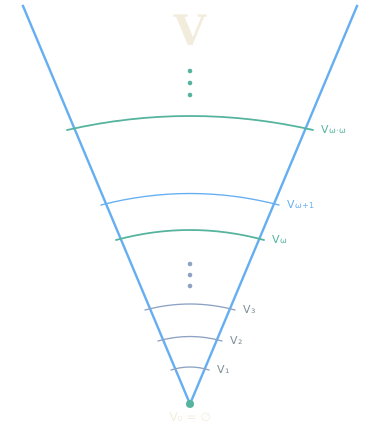
Set theory gives mathematics a singular ontology: every object lives in one universe, and membership is the basic relation. The iterative conception organizes this universe and gives us an intuitive picture of its structure. Start from the empty set, form new sets from what is already there, and continue through the transfinite. The result is the cumulative hierarchy, a common setting for numbers, functions, spaces, structures and morphisms that leaves mathematicians free to study each through its own properties. That combination of unity and freedom is beautiful and powerful, and is to me the gold standard foundation of classical mathematics.
noncomputable transfinite def V (α : Ordinal) : Set
  | 0 => ∅
  | succ β => 𝒫(V β)
  | limit λ => ⋃ { V β | β < λ }
Grace17 is my personal research project, and it is evolving as I learn from building it and proving theorems in it. The question I am investigating is whether set theory in first-order logic, the foundation with which mathematicians are most familiar, can support a modern, efficient, ergonomic proof assistant for people and AI systems alike. That means "Mathematics 1.0," the everyday mathematics we write and teach, and also "Mathematics 2.0" in Tao's sense: mathematics increasingly discovered with AI, where a proof may arrive from a machine and the human work shifts to understanding it, questioning it, and building the tools that make that understanding possible.
Formal proof is an essential component of trust in this new world, and it would be a fine thing if new discoveries were formalized in both type theory and set theory, each foundation illuminating the other. For that to happen, set theory needs a modern, efficient, mainstream prover, and that is what Grace17 aims to be: a system beautiful and powerful enough that set-theoretic formalization becomes standard practice.
Please note: Grace17 is a research prototype, not a mature industrial-strength system like Lean. Lean sets an extraordinary example: a proof assistant that is also an industrial-strength programming language, with the community and the library to match. Grace17 is not a general-purpose programming language, though it does have a foundational method for using efficient computation within set-theoretic proofs. Our library, Cumulus, is tiny next to the largest libraries, but it is growing alongside the language and the automation, so real proofs shape the system at a stage when a single development can still change how it feels to use. If this sounds like fun, I welcome your contributions.
A place in a pluralistic mathematical world#
Mathematics is better for having many foundations, tools, and habits of thought. Grace17 welcomes mathematicians new to formal proof as well as users of Lean, Mizar, ACL2, Isabelle, Rocq, PVS, Agda, Metamath, HOL Light, HOL4, ProofPower, Naproche, and others to contribute and help us improve the system. Experience in any of those communities is useful here, and I hope ideas and examples travel in both directions.
Grace17 draws on several traditions: readable formal proofs, small checkers with explicit certificates, executable definitions, set-theoretic formalisms with soft typing, and strong automation whose output can be checked independently. What is particular here is bringing them together around set theory, with human and AI participation designed in from the start.
Grace17 grows out of longstanding work in automated reasoning and formal verification and a wish to bring set theory into the mainstream of formal proof. I (Grant Passmore) have been inspired by many friends and collaborators, including Bob Boyer, J Moore, Leo de Moura, Jeremy Avigad, Matt Kaufmann, Jared Davis, Larry Paulson, Natarajan Shankar, Sam Owre, Paul Jackson, Wenda Li, Marijn Heule, Yves Bertot, Assia Mahboubi, Bas Spitters, André Platzer, Larry Wos, Michael Beeson, Yuri Gurevich, Nikolaj Bjorner, Denis Ignatovich, András Salamon, Christoph Wintersteiger, Simon Cruanes, Thomas Forster, Peter Koepke, Norm Megill, John Harrison, Mike Gordon, Magnus Myreen, Rob Arthan, Roger Bishop Jones, Robin Milner, and many others. My design decisions would not be the same without their work and ideas (though I must take credit for all decisions they would disagree with! :-)).
Mathematics in sets#
Mathematical objects in Grace17 inhabit one universe of sets. A group has a
carrier set and operations, a function is a set of ordered pairs, a quotient
is a set of equivalence classes, and membership and equality are propositions
you use in proofs. (A B x : Set) introduces three arbitrary sets, and
x ∈ A says that one belongs to another. Set names the domain of discourse;
it does not assert that there is a set of all sets. Proper classes are
described by predicates.
Annotations such as (x : Integer) are soft types: the annotation is a
hypothesis that Integer(x) holds. Carrier conditions are inferred, proved,
and passed to theorems like any other mathematics, and automation discharges
them when the evidence at hand suffices.
Functions show the same idea at work. A function is a set of ordered pairs,
and FunctionBetween(f, A, B) says that f is one with domain A and
values in B. The binder (f : A → B) is soft-typing sugar for that
hypothesis, and f : A → B can also stand on its own wherever a formula
can. The automation makes the sugar seamless: with * finds the function
hypothesis when a library theorem needs it, synthesize builds facts such
as "the composite of f : A → B and g : B → C is a function A → C" from
the declared instances for composition, identity, and constant functions,
and unfold FunctionBetween exposes the set of pairs whenever a proof wants
to reason about it directly.
theorem value_in_codomain (A B x : Set) (f : A → B)
  requires hx : x ∈ A
  shows f(x) ∈ B
proof
  exact FunctionBetween.apply_closed with *
You write x + y, A ⊆ B, f(x), and ∃ x ∈ A, P(x) as usual. Scoped
notation lets the algebraic context fix which operations are meant.
Definitions and notation keep the underlying set constructions out of everyday
proofs while leaving them open to inspection.
A design question I care about is how to bring efficient computation into a set-theoretic system in a fully foundational way, so that computing inside a proof is natural and its correctness rests on the foundations. Matt Kaufmann's ACL2(zf) has been a major influence on my approach.
Try a first proof#
The whole proof assistant runs in your browser, and nothing is sent to a server. Each code block below has a Workbench button. Press it, move the cursor through the proof, and watch the goals and hypotheses change. Hover information, navigation, library search, and the Help panel are there for exploring, and the Workbench opens any Cumulus module the same way. The examples are collected in examples/Introduction.g17.
A complete small file with a basic set argument, the kind of reasoning every mathematician does without thinking: if A is inside B and B is inside C, then A is inside C.
module FirstSteps
import Grace.Cumulus.Set

theorem subset_transitive (A B C : Set)
  requires hab : A ⊆ B
  requires hbc : B ⊆ C
  shows A ⊆ C
proof
  intros x hx
  have hb := hab with x, hx
  exact hbc with x, hb
Read the statement as: let A, B, and C be sets; if A is a subset of B and B
is a subset of C, then A is a subset of C. requires names the hypotheses
and shows states the conclusion. The proof is the one you would give at a
blackboard. To show A ⊆ C, take an arbitrary element of A: intros x hx
names it x and names the fact hx : x ∈ A. A subset hypothesis says that
every element of the smaller set belongs to the larger one, so applying
hab to x and hx with with gives x ∈ B, recorded under the name
hb. Applying hbc the same way gives x ∈ C, which is the goal, and
exact closes it.
The module names the file. The namespace groups its declarations: inside it
the theorem is subset_transitive, and its qualified name is
FirstSteps.subset_transitive. Importing a module makes its definitions and
theorems available through their declared scopes.
Building with existing mathematics#
Cumulus already proves that inclusion is transitive. In the same context:
theorem subset_chain (A B C : Set)
  requires first : A ⊆ B
  requires second : B ⊆ C
  shows A ⊆ C
proof
  exact Subset.transitive with *
The goal and the local hypotheses determine the parameters and premises, and
with * asks for bounded automatic matching of the available evidence. You
can also write the application out:
exact Subset.transitive at A, B, C with first, secondat supplies mathematical arguments and with supplies proofs of premises.
The explicit form is for when inference needs guidance; if several
interpretations fit, choosing the intended one is part of explaining the
mathematics to the system.
Proofs introduce local facts with have, take witnesses with obtain,
rewrite with rw, and present chains of equalities with calc. Sections share
variables and hypotheses across related theorems. See the
theorem-section examples and the
algebraic hierarchy.
Sets, naturally#
Everyday set-theoretic reasoning is pleasant with familiar moves available
through basic tactics. An inclusion is proved by taking an arbitrary member, an
equation between sets by taking an arbitrary element of either side, and the
membership logic of ∅, ∪, ∩, ∖, {x}, and 𝒫 is settled by simp
from the hypotheses in play:
theorem meet_commutes (A B : Set)
  shows A ∩ B = B ∩ A
proof
  ext y
  simp

theorem difference_mono (A B C : Set)
  requires h : A ⊆ B
  shows A ∖ C ⊆ B ∖ C
proof
  simp

theorem meet_below (A B : Set)
  shows A ∩ B ⊆ A
proof
  intros x hx
  obtain ⟨ha, hb⟩ := intersection.membership.forward with hx
  exact ha

theorem singleton_below (x A : Set)
  requires h : x ∈ A
  shows {x} ⊆ A
proof
  intros y hy
  have eq := singleton.membership.forward with hy
  rwa eq
intros x hx sees through the definition of ⊆, a membership lemma applied
with with finds its parameters in the goal, obtain takes a conjunction or
an existential apart, and rwa rewrites and closes with a hypothesis. The
same forms carry over unchanged to functions, orders, numbers, and structures,
which the Set Theory Game introduces one world at a
time.
Natural reasoning with algebraic structures#
A group in Cumulus is a set, a structure whose
fields are its carrier, its operation, its unit, and its inverse, with the
group laws as the where clauses:
structure Group
  | carrier : Set
  | mul : carrier × carrier → carrier
  | one : carrier
  | inv : carrier → carrier
  where
    mul_assoc : ∀ a b c ∈ carrier, mul(mul(a, b), c) = mul(a, mul(b, c))
    one_mul : ∀ a ∈ carrier, mul(one, a) = a
    mul_one : ∀ a ∈ carrier, mul(a, one) = a
    inv_mul : ∀ a ∈ carrier, mul(inv(a), a) = one
mul_inv : ∀ a ∈ carrier, mul(a, inv(a)) = oneGroup(G) then says that G is such a structure satisfying the laws, and
G.carrier, G.mul, G.one, and G.inv are projections giving you the
fields. The notation of group theory is declared once, to be supplied by that
hypothesis wherever it is in scope:
notation infixl 70 "*" => call2(G.mul, _, _) via hypothesis Group(G) for G.carrier
notation infixl 70 "*" => call2(G.mul, _, _) via hypothesis AbelianGroup(G) for G.carrier
notation postfix 90 "⁻¹" => apply(G.inv, _) via hypothesis Group(G) for G.carrier
So a development opens a section on a group,
section GroupLaws
variable (G : Set)
hypothesis group : Group(G)
and from then on a binder (a b : G) means membership in the carrier,
a * b is the operation, and a⁻¹ the inverse. The cancellation law is a
three-line calculation:
theorem mul_left_cancel (a b c : G)
  requires equal : a * b = a * c
  shows b = c
proof
  calc
    b = a⁻¹ * (a * b) := by rw inv_mul_cancel_left
    _ = a⁻¹ * (a * c) := by rw equal
    _ = c := by rw inv_mul_cancel_left
Lagrange's theorem reads quite naturally. With a subgroup in scope,
section Lagrange
variable (G H : Set)
hypothesis group : Group(G)
hypothesis subgroup : Subgroup(H, G)
the order of a finite group is the index times the order of the subgroup, because the group is the disjoint union of the cosets, each of the size of the subgroup:
theorem lagrange
  requires finite : Finite(G)
  shows order(G) = index(G, H) * cardinality(H)
proof
  have finiteH := Subgroup.finite with *
  have finiteCosets := leftCosets.finite with *
  have subgroupNat := cardinality.nat with finiteH
  have cosetsNat := cardinality.nat with finiteCosets
  have indexNat := index.nat with *
  have blocks : ∀ C ∈ leftCosets(G, H), Finite(C)
    intros C hC
    exact leftCosets.member_finite with *
  have sizes : ∀ C ∈ leftCosets(G, H), cardinality(C) = cardinality(H)
    intros C hC
    exact leftCosets.member_cardinality with *
  have disjoint := leftCosets.pairwise_disjoint with *
  calc
    order(G) = cardinality(G) := order.value at G
    _ = cardinality(⋃(leftCosets(G, H))) := by rw leftCosets.cover
    _ = cardinality(leftCosets(G, H)) * cardinality(H) :=
      cardinality.big_union_constant with finiteCosets, blocks, disjoint, sizes
    _ = index(G, H) * cardinality(H) := by rw index.value
Rings are defined analogously, and under CommRing(R) the operations are
x + y, x * y, and -x, the ring's own numerals are R[0], R[1],
R[2], and ring closes a polynomial identity from the laws supplied by
the hypothesis:
section Rings
variable (R : Set)
hypothesis ring : CommRing(R)

theorem square_sum (x y : R)
  shows (x + y) * (x + y) = x * x + R[2] * (x * y) + y * y
proof
  ring
An ideal is defined inside a section on the ring, so its definition is the
textbook one and is a formula over the projections of R:
section Definitions
variable (R : Set)
hypothesis ring : Ring(R)

predicate Ideal (I : Set) :=
  I ⊆ R ∧ R[0] ∈ I ∧ (∀ x y ∈ I, x + y ∈ I) ∧
  (∀ x ∈ I, -x ∈ I) ∧ (∀ a ∈ R, ∀ x ∈ I, a * x ∈ I ∧ x * a ∈ I)
predicate ProperIdeal (I : Set) := Ideal(I) ∧ R[1] ∉ I
predicate MaximalIdeal (M : Set) :=
  ProperIdeal(M) ∧ (∀ J, ProperIdeal(J) → M ⊆ J → J = M)
Under Ideal(R, I) a binder (x : I) is membership in the ideal and its
elements carry the ring notation, and the closure facts are instances, so
the automation finds them when a membership is needed:
instance Ideal.add_mem (x y : I)
  shows x + y ∈ I
proof
  obtain ⟨bounded, zeroIn, sums, negatives, products⟩ := ideal
  have xIn : x ∈ I by assumption
  have yIn : y ∈ I by assumption
exact sums with x, xIn, y, yIninstance Ideal.sub_mem (x y : I)
shows x - y ∈ I
proof
have xIn : x ∈ R := Ideal.mem_carrier with *
have yIn : y ∈ R := Ideal.mem_carrier with *
have negIn : -y ∈ I := Ideal.neg_mem with *
rw Ring.sub.value
exact Ideal.add_mem with *A ring homomorphism is a hypothesis f : R →+* S,
section HomLaws
variable (f R S : Set)
hypothesis hom : f : R →+* Stheorem RingHom.map_add (a b : R)
shows f(a + b) = f(a) + f(b)the quotient by an ideal is R ⧸ I, and the first isomorphism theorem is
stated as a mathematician would state it, for a surjective homomorphism:
theorem RingHom.first_isomorphism
  requires onto : SurjectiveBetween(f, R.carrier, S.carrier)
  shows inducedMap(f) : R ⧸ ker(f) ≃+* S
The closure facts above are instances, and an instance is a checked
theorem registered for bounded, proof-producing search; the
complex ring development
registers the complex numbers as a commutative ring the same way:
instance complexes.comm_ring
  shows IsCommRing(ℂ)
typecheck discharges carrier and soft-type obligations from such
instances, with * supplies premises from them and from the hypotheses in
scope, and when a choice is ambiguous you make it explicit; see
types and instances and the algebraic hierarchy.
Certificates you can read#
Proofs are natural deduction derivations, and they can be inspected and are often quite readable. The Workbench shows the checked derivation of any theorem under Kernel proof, in Fitch style with numbered lines and assumption rails; here is the first proof above, rendered from its certificate:
1∀ A, ∀ B, A ⊆ B ↔ ∀ x ∈ A, x ∈ BdefDefinition equation
∀ A, ∀ B, A ⊆ B ↔ ∀ x ∈ A, x ∈ B- declaration
- Grace.Cumulus.Set.Basic.Set.Subset
- equation
- equation
2∀ B, A ⊆ B ↔ ∀ x ∈ A, x ∈ B∀E 1Universal specialization
∀ A, ∀ B, A ⊆ B ↔ ∀ x ∈ A, x ∈ Buniversal statement · line 1∀ B, A ⊆ B ↔ ∀ x ∈ A, x ∈ B- term
- A
3A ⊆ B ↔ ∀ x ∈ A, x ∈ B∀E 1–2Universal specialization
∀ B, A ⊆ B ↔ ∀ x ∈ A, x ∈ Buniversal statement · line 1–2A ⊆ B ↔ ∀ x ∈ A, x ∈ B- term
- B
4A ⊆ B → ∀ x ∈ A, x ∈ B↔E₁ 1–3Forward equivalence elimination
A ⊆ B ↔ ∀ x ∈ A, x ∈ Bequivalence · line 1–3A ⊆ B → ∀ x ∈ A, x ∈ B5A ⊆ BhypHypothesis
A ⊆ B6∀ x ∈ A, x ∈ B→E 1–4, 1–5Modus ponens
A ⊆ B → ∀ x ∈ A, x ∈ Bimplication · line 1–4A ⊆ Bantecedent · line 1–5∀ x ∈ A, x ∈ B7x ∈ A → x ∈ B∀E 1–6Universal specialization
∀ x ∈ A, x ∈ Buniversal statement · line 1–6x ∈ A → x ∈ B- term
- x
8x ∈ AhypHypothesis
x ∈ A10x ∈ A → x ∈ B→I 1–9Implication introduction
[x ∈ A]x ∈ Bconclusion under assumption · line 1–9x ∈ A → x ∈ B- discharged assumption
- x ∈ A
11A ⊆ B → x ∈ A → x ∈ B→I 10Implication introduction
[A ⊆ B]x ∈ A → x ∈ Bconclusion under assumption · line 10A ⊆ B → x ∈ A → x ∈ B- discharged assumption
- A ⊆ B
12∀ x, A ⊆ B → x ∈ A → x ∈ B∀I 11Universal introduction
A ⊆ B → x ∈ A → x ∈ Bbody for fresh variable · line 11∀ x, A ⊆ B → x ∈ A → x ∈ B- bound variable
- x
13∀ B, ∀ x, A ⊆ B → x ∈ A → x ∈ B∀I 12Universal introduction
∀ x, A ⊆ B → x ∈ A → x ∈ Bbody for fresh variable · line 12∀ B, ∀ x, A ⊆ B → x ∈ A → x ∈ B- bound variable
- B
14∀ A, ∀ B, ∀ x, A ⊆ B → x ∈ A → x ∈ B∀I 13Universal introduction
∀ B, ∀ x, A ⊆ B → x ∈ A → x ∈ Bbody for fresh variable · line 13∀ A, ∀ B, ∀ x, A ⊆ B → x ∈ A → x ∈ B- bound variable
- A
Natural deduction certificates shows the same
derivation as a Gentzen tree, the derivation a tactic such as ring
produces for an identity, and how to open the derivation of any theorem in
Cumulus.
A seamless path to the transfinite#
The same language scales from small set arguments to transfinite constructions, abstract algebra, and analysis. The excerpts below come from Cumulus and its checked examples; each depends on its module's namespace, imports, and surrounding context, so follow the source links for the complete developments.
Proper classes and the cumulative hierarchy#
A collection need not be a set to have useful notation. Classes.g17 defines the universal class:
class Universe (x : Set) := { x | x = x }
class Natural (x : Set) := Nat(x)
class MemberOf (x A : Set) := x ∈ A
class SubsetsOf (A : Class) := { X : Set | ∀ x ∈ X, x ∈ A }
class Inhabited (A : Set) := ∃ x, x ∈ A
class introduces a predicate on sets. x ∈ Universe is meaningful, but
Universe is not a set containing every set, and class equality is pointwise
equivalence. This gives class notation inside the set-theoretic foundation
without adding classes as objects. A class may describe a set-sized
collection or a proper class; the keyword alone does not say which.
The ordinals are described the same way:
predicate Transitive (A : Set) := ∀ x ∈ A, (x ⊆ A)
class Ordinal (α : Set) := { α | Transitive(α) ∧ (∀ β ∈ α, Transitive(β)) }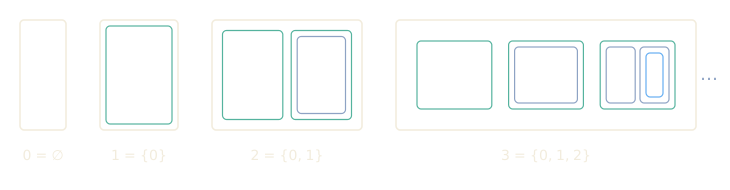
With Foundation this is the von Neumann characterization of ordinals. An
annotation (α : Ordinal) supplies ordinal evidence; α ∈ Ordinal states the
same condition as a proposition.
The cumulative hierarchy has its usual definition by transfinite recursion:
noncomputable transfinite def V (α : Ordinal) : Set
  | 0 => ∅
  | succ β => 𝒫(V β)
  | limit λ => ⋃ { V β | β < λ }
A successor stage takes a powerset and a limit stage takes the union of the
earlier stages. The recursion is class-sized, but each value V(α) is a set:
the limit expression collects the earlier values over a set-sized ordinal by
Replacement. noncomputable marks a foundational definition with no
executable enumeration.

A Foundation-recursive ordinal bound witnesses that every set belongs to some stage. The final theorem is short because the construction and its properties are already proved:
theorem rank.exists (x : Set)
  shows ∃ α, α ∈ Ordinal ∧ x ∈ V(α)
proof
  refine ⟨rank(x), rank.ordinal at x, rank.membership at x⟩
Here rank is a sufficient ordinal height rather than the least one; what
matters is that every set occurs in the hierarchy. In class notation:
theorem CumulativeUniverse.eq_Universe
  shows CumulativeUniverse = Universe
proof
  apply CumulativeUniverse.eq_Universe_of_rank
  intro x
  exact rank.exists
CumulativeUniverse is the class of sets belonging to some V(α), so the
identity says the hierarchy exhausts the universe of sets. The universe is
still a class.
Choice and Zorn's lemma#
Zorn.g17 proves the maximal-element
principle. ZornCondition(A, r) says r is a partial order on A and every
chain, the empty chain included, has an upper bound in A. The complete final
proof:
theorem Zorn.theorem (A r : Set)
  requires zorn : ZornCondition(A, r)
  shows ∃ m, Maximal(A, r, m)
proof
  obtain ⟨c, choice⟩ := SubsetChoice.exists at A
  by_contra none
  have noMaximal : NoMaximal(A, r)
    intros x hx maximal
    apply none
    witness x
    exact maximal
  have ordinal := hartogsBound.ordinal at A
  have injection := zornSequence.injective with *
  exact hartogsBound.no_injection with injection
Assuming there is no maximal element, the proof chooses successors, builds an
increasing transfinite sequence, and contradicts Hartogs' theorem: some
ordinal cannot inject into A. The construction lives in the preceding
lemmas. This proof uses choice, and the axiom audit shows the hereditary
dependency.
One application in the same file is the maximal-chain principle:
theorem Chain.exists_maximal (A r : Set)
  shows ∃ C, Chain(A, r, C) ∧ (∀ D, Chain(A, r, D) → C ⊆ D → D = C)
The Banach–Tarski paradox#
The axiom of choice has a famous consequence: the closed unit ball of ℝ³ can
be cut into finitely many pieces that reassemble, by rotations and
translations, into two balls. Cumulus proves it first as a paradoxical
decomposition and then in that strong form. Under an action of a group G
on a set X, two subsets are
equidecomposable when finitely many pieces of one are carried onto a
partition of the other by elements of G, and X is paradoxical when two
disjoint subsets are each equidecomposable with all of X:
predicate Paradoxical (act G X : Set) :=
  ∃ A, ∃ B, A ⊆ X ∧ B ⊆ X ∧ Disjoint(A, B) ∧
    Equidecomposable(act, G, X, A, X) ∧ Equidecomposable(act, G, X, B, X)
The theorem for the ball, under the group Motions of orientation-preserving
isometries of ℝ³ acting on the space, is
banachTarski:
theorem banachTarski
  shows ∃ A, ∃ B, A ⊆ unitBall ∧ B ⊆ unitBall ∧ Disjoint(A, B) ∧
    Equidecomposable(motionAction, Motions, ℝ³, A, unitBall) ∧
    Equidecomposable(motionAction, Motions, ℝ³, B, unitBall)
The route is the classical one. The free group on two letters is built from reduced words; two explicit rotations with entries 3/5 and 4/5 generate it freely, by Swierczkowski's argument with integer vectors modulo 5, so no trigonometry enters; the free group acts freely on the sphere minus the countable set of points fixed by its nontrivial words, which gives Hausdorff's paradox there; a rotation of infinite order absorbs that countable set, so the sphere itself is paradoxical; cones carry the pieces to the punctured ball, and a rotation about an off-center axis absorbs the center. The step from the sphere minus the fixed points to the sphere itself is a few lines once the pieces are in hand:
theorem sphere.paradoxical
  shows Paradoxical(sphereAction, SO3, S²)
proof
  have action := sphereAction.action
  have subset := difference.subset_left at S², wordFixedSet
  have whole := sphere.absorb_any
    with wordFixedSet.countable, wordFixedSet.subset
  exact Paradoxical.of_equidecomposable
    with action, subset, whole, hausdorff.pieces
The axiom audit of banachTarski names the ZF axioms and the axiom of
choice, which is used exactly once, to pick one point in each orbit of the
free group. The strong form follows by the Schröder–Bernstein argument
carried out for equidecomposability, Equidecomposable.of_embeddings:
banachTarski.two_balls says that the ball is equidecomposable with the
disjoint union of the ball and a translate of it.
A few Top 100 milestones#
The Top 100 is a beautiful list of theorems across many areas of mathematics, with Grace17 formalizations for a growing collection. I welcome contributions!
Fundamental Theorem of Algebra (No. 2). Every nonconstant monic complex
polynomial has a root. In the coefficient-list representation the leading
coefficient 1 is implicit and cs ≠ [] expresses nonconstancy:
theorem complexPolynomial.has_root (cs : List(ℂ))
  requires nonconstant : cs ≠ []
shows ∃ a ∈ ℂ, complexPolynomial(cs)(a) = ℂ[0]Infinitude of primes (No. 11). Primes exceed every natural bound:
theorem primes.order_unbounded (n : Nat)
  shows ∃ p ∈ primes, n < p
The same development proves
¬Finite(primes), tying the order statement to set-theoretic infinitude.
Fundamental Theorem of Calculus (No. 15). Differentiating the integral of a continuous function recovers the function at interior points:
theorem FTC.derivative_of_integral (f : Set) (A B X : Real)
  requires continuous : ContinuousOn(f, closedInterval(A, B))
  requires left : A < X
  requires right : X < B
  shows HasDerivativeAt(integralFrom(f, A, B), f(X), X)
The integral is the Riemann integral on a real closed interval, and the development also proves the endpoint-difference form for continuous derivatives.
The catalogue also has the Pythagorean theorem, the uncountability of the Dedekind reals, Bézout's identity, the mean value theorem, and Cauchy–Schwarz, each with its stated scope. These developments double as experiments in language design: substantial mathematics shows where notation, inference, and automation still fall short.
Foundations and choice#
Like Lean and Metamath, Grace17 produces proof objects that independent checkers can verify. There are checkers in Python, OCaml, and Rust alongside the TypeScript implementation, each able to rebuild the whole library from the bare axioms; formally verified checkers are a research goal, and the existing ones are not yet verified.
The command line supports three profiles: ZF, ZFC (ZF with the Axiom
of Choice), and ZFG (with a global choice selector). The Workbench uses
ZFG. A theorem checked under ZFG may still have a proof that uses no choice
axiom, and the axiom audit reports local and hereditary dependencies so you can
tell what the environment permits from what a proof uses. The command line
needs a checkout of the repository and Node.js 24 or later. After npm ci,
this checks the introduction's examples and audits one of its theorems:
node bin/g17.ts check --foundation ZF --module-root lib examples/Introduction.g17
node bin/g17.ts axiom-audit --foundation ZF --module-root lib examples/Introduction.g17 --theorem Introduction.difference_of_squares
Definitions and set constructions have foundational obligations too, and Grace17 checks the relevant declaration events. Checking a proof tape against an exported environment and reconstructing that environment are different validation tasks; the foundation contract and the independent checker documentation draw the boundaries, and checker semantics states what every checker computes.
Humans and AI working on the same mathematics#
Humans and AI agents should be able to work together on the same mathematics in a foundation that helps facilitate human intuition and understanding. Agents should be able to inspect proof states, propose local changes, search a library, and get precise feedback from a checker, and human readers should be able to follow and review what comes out. Today Grace17 offers command-line checking with JSON output, structured proof information, proof export, axiom auditing, and library search, which are the building blocks for agent workflows; the guide for AI agents describes these interfaces and a working loop for proving with them. Richer integrated assistance is part of the research programme. Different tools and model providers can work with the same checked mathematics. Humans remain responsible for choosing the definitions and statements that capture what they mean.
Where to explore next#
Cumulus has developments in set theory, ordinals and cardinals, order theory and lattices, lists, number theory, combinatorics, finite probability, group theory, commutative algebra, linear algebra, Euclidean geometry, graph theory, topology, metric spaces, real and complex analysis, category theory, fixed point theorems, and game theory, among them the Fundamental Theorem of Calculus, the Fundamental Theorem of Algebra, Brouwer's fixed point theorem, Nash equilibria for finite games, and a concrete weak Nullstellensatz, and it is growing rapidly. The checked source and the axiom audits give the precise statements and assumptions.
- The Set Theory Game: a guided path from membership to uncountable sets, each level a checked theorem.
- Top 100 catalogue: informal statements, formal statements, and proof links.
- Erdős problem 397: a recent AI-found resolution, checked independently from the axioms.
- Integer algebra: small examples of polynomial reasoning.
- Theorem sections: proofs with shared context.
- Build your own library: separate projects and reproducible checks.
- Library search: finding results and exploring their statements.
- Workbench guide: editor and project workflows.
- Notation guide: mathematical notation and input.
Grace17 is still developing. Cumulus is much smaller than the mature libraries, and some constructions still need more carrier and operation information than I would like. Predictable inference, readable proofs, efficient checking, and a dependable contributor experience are active work. It is truly an open question whether or not the system I am dreaming of is possible at scale.